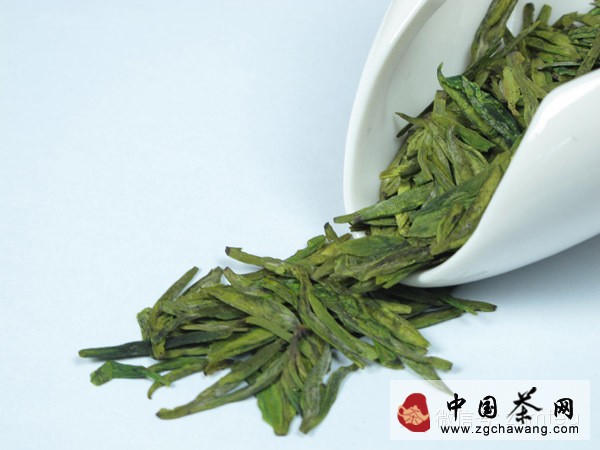
The evaluation of Longjing tea is similar to other famous premium green teas, primarily involving the dry assessment of appearance, and the wet assessment of liquor color, aroma, taste, brewed leaves, as well as distinguishing the origin of the Longjing tea.
1. Appearance Evaluation: Take about 100g of representative tea leaves, place them in a tea sample tray to assess the appearance, mainly evaluating factors such as shape, color, and fuzziness. Through appearance assessment, one can determine whether it belongs to West Lake Longjing or Zhejiang Longjing. The appearance of these two teas is very similar. Furthermore, some flat-shaped teas produced in other tea regions using Longjing cultivar fresh leaves (such as Longjing 43, Longjing Changye) are also very close in appearance to West Lake Longjing, making it difficult to distinguish the origin of Longjing tea. This is the reason for the混乱 (confusion) in labeling found in the current market. However, experienced evaluators can distinguish the origin of most teas based on the basic characteristics of Longjing tea's appearance.
2. Tea Liquor Color Evaluation: The liquor color of high-grade tea is mostly tender green or tender yellow. The liquor color of medium and low-grade teas, or teas that have lost freshness or absorbed moisture, tends to be yellowish-brown. It is not easy to judge the origin of Longjing tea from the liquor color, and it is not necessary to force a distinction.
3. Aroma and Taste Evaluation: Early spring teas produced in the Meijiawu and Shifeng areas of the West Lake region, if processed normally without over-fired or raw green odors, show certain differences in aroma and taste between top-grade West Lake Longjing and top-grade Zhejiang Longjing. West Lake Longjing has a tender fragrance with a fresh aroma, and the taste is relatively clear, fresh, and soft. Zhejiang Longjing has a tender chestnut-like aroma, and the taste is relatively mellow and full. If "multi-functional machines" are used for processing West Lake Longjing and Zhejiang Longjing, due to the change from the traditional Longjing tea making process, the aroma of the two does not show a significant difference. Most other flat teas exhibit the flavor of tender pan-fired green tea. However, even West Lake Longjing, once over-fired to develop a roasted soybean aroma, becomes difficult to distinguish by origin based on aroma. In the Jiangnan tea region, Longjing tea stored at room conditions tends to have a yellower liquor color and a duller aroma after the rainy season.
4. Evaluation of Brewed Leaves: The assessment of brewed leaves mainly focuses on color, tenderness, and integrity. Sometimes, the tea residue from the cup is poured into a rectangular enamel tray, cold water is added, and the evenness of tenderness is observed, which can serve as a reference for grading.
5. Grading of Longjing Tea: The grade of Longjing tea should be determined by comparison with standard samples. If the appearance differs from the standard sample (e.g., organic tea), the grade can only be determined based on tenderness equivalent to the standard sample. Currently, most bulk Longjing tea is marketed immediately after production, with some ungraded and only priced. For pre-packaged Longjing tea, the product name and grade must be labeled, and these teas should be evaluated against standard samples. The grade of Longjing tea has a certain relationship with color. For high-grade spring tea, bright green is excellent, tender yellow is medium, and dark brown is inferior. Longjing tea made in summer and autumn, with a dull blue or grayish-brown color, is one characteristic of lower quality. Machine-made Longjing tea tends to have a darker green color.