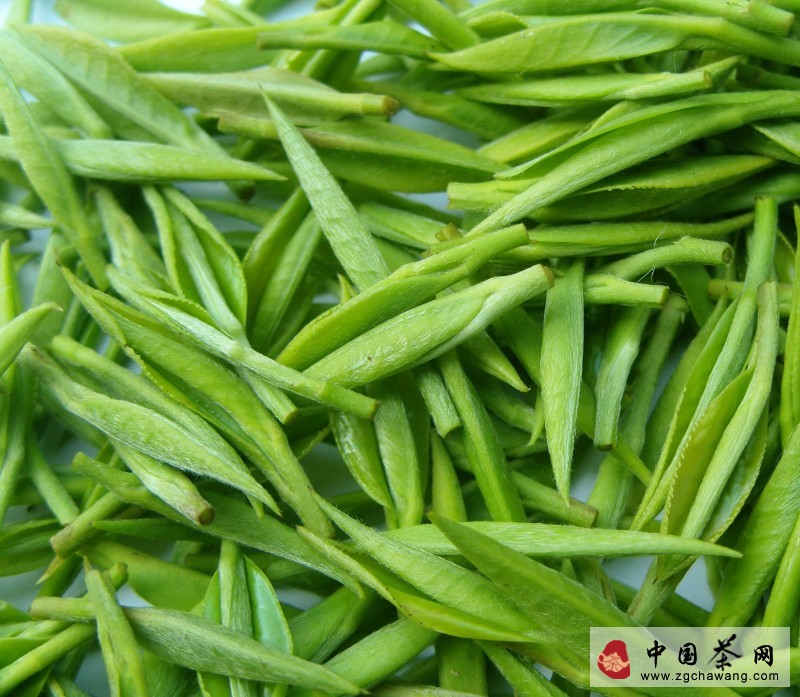
Green tea is the tea category with the longest production history and the most varieties in China. Its processing involves picking tender buds and leaves, followed by high-temperature deactivation to prevent fermentation, preserving its characteristic emerald green color and forming its unique appearance, aroma, taste, and shape. After brewing, the tea exhibits a green color and clear liquor, with a subtle, elegant fragrance and a fresh, brisk taste. Green tea is considered cooling in nature. Based on differences in the deactivation or drying methods, it is generally classified into steamed green tea, pan-fired green tea, baked green tea, and sun-dried green tea.
Steamed green tea is one of the earliest processing methods invented in ancient China for green tea, which became popular during the Tang and Song dynasties and was later introduced to Japan. After the pan-firing method was promoted in China during the Ming Dynasty, steamed green tea gradually declined, but Japan has continued this tradition to this day, further researching and implementing mechanized production. Modern steamed green tea in China is mainly produced in Zhejiang, Fujian, and Anhui provinces, with most of the products exported to Japan. Steamed green tea is characterized by its "three greens": green dry leaves, green liquor, and green brewed leaves. High-grade steamed green tea has tightly rolled, needle-shaped leaves, a fresh and clear aroma, and a sweet, mellow taste.
Pan-fired green tea originated around the Southern Song Dynasty and became widely adopted during the Ming Dynasty. Since then, it has been the most fundamental processing method for green tea, accounting for the vast majority of production. Based on the shape of the leaves after pan-firing, pan-fired green tea is divided into long-pan-fired (e.g., Mei Cha or Eyebrow Tea), flat-pan-fired (also called round-pan-fired, e.g., Zhu Cha or Pearl Tea), and flat-pan-fired (e.g., Longjing, Qiqiang, Dafang). Mei Cha, or Eyebrow Tea, has curved, strip-like leaves, a glossy green color, and a frosty bloom, resembling a beautiful woman's eyebrows, hence the name. It is mainly produced in Zhejiang, Anhui, and Jiangxi provinces. Zhu Cha, or Pearl Tea, has tightly rolled, round, pearl-like leaves that are heavy and solid, hence the name "pearl." Its main production area is in Zhejiang province. As it was historically processed and traded in Pingshui Town southeast of Shaoxing City, it is known in the international tea market as "Pingshui Pearl Tea."
Baked green tea gets its name because the fresh leaves are dried using a baking process after deactivation and rolling. The appearance of baked green tea is not as smooth and tight as pan-fired green tea, but the strips are complete, with visible tips, a green and glossy color, a clear green liquor, and a mellow aroma and taste. Baked green tea can be categorized by shape into strip-shaped (e.g., Huangshan Maofeng), pointed-shaped (e.g., Taiping Houkui), flake-shaped (e.g., Lu'an Guapian), and needle-shaped (e.g., Xinyang Maojian). Baked green tea is also used for scenting flower teas, such as Jasmine Baked Green Tea and White Orchid Baked Green Tea. Therefore, it is customary to call the scented ones "Flower Baked Green Tea" and the unscented ones "Plain Baked Green Tea".
Sun-dried green tea is made by sun-drying the fresh leaves after deactivation and rolling. Generally, sun-dried green tea has a lower aroma, and the liquor and brewed leaves show a yellowish-brown color. Main varieties include Yunnan's "Dian Qing," Shaanxi's "Shan Qing," Sichuan's "Chuan Qing," Guizhou's "Qian Qing," and Guangxi's "Gui Qing." Most sun-dried green tea is used as raw material for compressed tea.