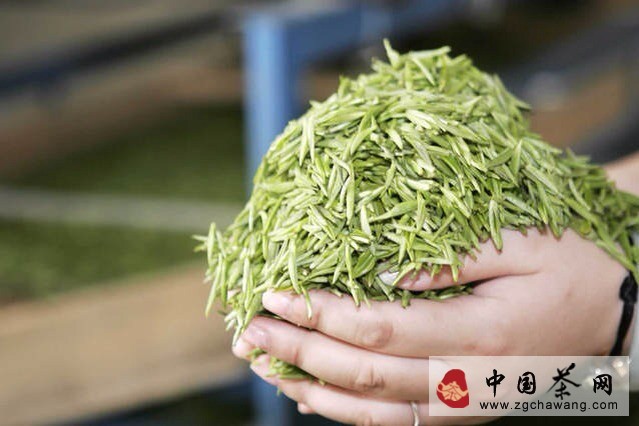
41. What honors has Ningqiang Queshe received?
Answer: In 1995, it won the "Houji" Gold Award at the China Agricultural Science and Technology Expo; in the same year, it was selected as a special supply tea for the General Office of the Central Committee; in 1997, it won the silver award at the China International Tea Expo.
42. What type of tea is Hanshui Yinsuo? When was it created? Where is it produced?
Answer: Hanshui Yinsuo was created by Wang Guozhi, Zhong Jihong, and others, and passed appraisal in 1986. It is a newly created semi-stir-fried and semi-baked type of green tea. It is produced in the Hongshan hilly area of Nanzheng County, Shaanxi Province.
43. What are the quality characteristics of Hanshui Yinsuo?
Answer: Hanshui Yinsuo is processed from tea leaves picked at the initial stage of one bud and one leaf. Its appearance is flat and uniform like a shuttle, with emerald green color and pekoe. It has a lasting tender aroma, containing an elegant and pleasant floral fragrance. The taste is fresh and mellow, with a sweet aftertaste and good infusibility. The brewed leaves are tender, yellow-green, and bright, with an attractive appearance.
44. What honors has Hanshui Yinsuo received?
Answer: In 1988, it won the "Bronze Medal" award at the First China Food Expo. In 1989, it was rated as a "National Famous Tea" by the Ministry of Agriculture. In 1997, it won the silver award at the China International Tea Expo.
45. What type of tea is Dingjun Mingmei? When was it first created? Where is it produced?
Answer: Dingjun Mingmei was created by Gao Junqing and others, and passed technical appraisal in 1990. It is a stir-fried and baked combined type of green tea. It is produced in the area south of Dingjun Mountain in Mian County, Shaanxi Province.
46. What are the quality characteristics of Dingjun Mingmei?
Answer: Dingjun Mingmei is refined from young tea leaves picked at the initial stage of one bud and two leaves. Its appearance is uniform and downy, as slender and elegant as eyebrows, with a tender green color and a lasting tender aroma.
47. What honors has Dingjun Mingmei received?
Answer: In 1992, it won first place in the Lu Yu Cup famous tea appraisal in western China. In the same year, it won the silver award at the China Agricultural Expo. Since 1996, it has been selected as a special supply tea for Zhongnanhai.
48. What is the economic status of Chinese green tea?
Answer: Green tea is the tea category with the longest history, richest variety, highest production, and widest consumption among the ten major tea categories in China. Currently, its production and sales account for nearly 80% of the national total tea output.
49. What famous high-quality green teas are produced in Shaanxi Province?
Answer: Shaanxi Province has many varieties of famous high-quality green teas. Thirty-two are listed in the "China Famous Tea Records," of which 16 have separate entries. They are: "Ankang Yinfeng" produced in Ankang City; "Bashan Biluo" and "Bashan Furong" produced in Langao County; "Chenggu Yinhao" produced in Chenggu County; "Dingjun Mingmei" produced in Mian County; "Selenium-rich Ziyang Tea Series Products" produced in Ziyang County; "Hanshui Yinsuo" produced in Nanzheng County; "Ningqiang Queshe" produced in Ningqiang County; "Qinba Wuhao" and "Qinba Maojian" produced in Zhenba County; "Shangnan Quanming" produced in Shangnan County; "Wuzi Xianhao" produced in Xixiang County; "Tianbao Gongming" produced in Hanyin County; and "Yinghu Xianming" produced in the Yinghu Scenic Area of Ankang.
50. What are the main tea-producing counties in Shaanxi Province?
Answer: Shaanxi Province is divided into five tea areas: First, the Ziyang tea area, mainly comprising Ziyang County and Langao County; second, the Southern Shaanxi hilly tea area, mainly comprising Nanzheng County and Chenggu County; third, the Western Hanzhong tea area, mainly comprising Mian County, Ningqiang County, and Lueyang County; fourth, the southern slope of Micang Mountain tea area, including parts of Xixiang County, Nanzheng County, and Zhenba County; fifth, the eastern Bashan low mountain and hilly tea area, mainly comprising Pingli County. In 2000, the counties with tea output exceeding 1 million kilograms were Ziyang County, Xixiang County, and Nanzheng County. Among them, Xixiang County ranked first with a tea output of 1.365 million kilograms.
51. What is black tea?
Answer: Black tea is a fully fermented tea produced from the buds, tender leaves, and tender stems of the tea plant through processes including withering, rolling, full fermentation, and drying.
52. When was black tea created? Where did it originate? What are its current categories?
Answer: Black tea was created in the Qing Dynasty and originated in Tongmu Guan, Wuyishan City (formerly Chong'an County), Fujian Province. Currently, black tea is divided into three categories: Souchong black tea, Gongfu black tea, and broken black tea. Broken black tea is also called CTC black tea.
53. What is the status of black tea in international tea trade? Which four black teas are known as the world's four high-aroma famous black teas?
Answer: Black tea is the most consumed tea category internationally, accounting for about 80% of international tea trade volume. India's Darjeeling black tea and Assam black tea, Sri Lanka's Uva black tea, and China's Keemun black tea are known as the world's four high-aroma black teas.
54. What are the quality characteristics of black tea?
Answer: Black tea is a fully fermented tea category, characterized by "red leaves, red liquor, and red brewed leaves." It has excellent compatibility and is most suitable for blending into various romantic beverages.
55. What is the fermentation of tea?
Answer: The fermentation of tea refers to the process where the colorless tea polyphenols in tea leaves are oxidized by oxygen in the air into black tea pigments.
56. What is Zhengshan Xiaozhong black tea? When was it created? Where is it produced?
Answer: Zhengshan Xiaozhong black tea is the originator of all black teas in the world. It was created in the Qing Dynasty and originally produced in the Tongmu Guan area of Xingcun Town, Wuyishan City (formerly Chong'an County), Fujian Province. Because it is a genuine high-mountain small-leaf black tea, it is named Zhengshan Xiaozhong. Small-leaf black tea produced in other towns of Wuyishan City, Jian'ou City, Guangze County, and other places is called Waishan Xiaozhong or Yan Xiaozhong.
57. What are the quality characteristics of Zhengshan Xiaozhong?
Answer: Zhengshan Xiaozhong has stout, tightly knotted, straight strips without buds or pekoe, a black and glossy appearance, a bright red liquor, a fragrant aroma with rich longan and pine smoke notes, and a mellow taste with a hint of honeyed jujube.
58. What honors has Zhengshan Xiaozhong received? Why is it in decline now?
Answer: Zhengshan Xiaozhong was a flagship export product during the Qing Dynasty, with an annual output reaching 300,000 kilograms. Shipped to the European market, it was deeply loved by the upper nobility, especially favored by the British Queen, becoming a royal treasure of the British royal family. Later, it became popular in high society, gradually forming tea drinking customs such as morning tea, afternoon tea, evening tea, and bedtime tea. Now, Tongmu Guan has been included in the UNESCO Man and the Biosphere Programme (MAB) as a Grade A nature reserve, where mountain clearing for tea planting is strictly prohibited. Therefore, its output is decreasing daily, making it an extremely precious and rare historical famous tea.
59. What is Keemun black tea? When was it created? Where is it produced?
Answer: The small-leaf Gongfu black tea produced in Qimen County, Anhui Province, is called Keemun black tea, abbreviated as Keemun. It was created by Yu Ganchen in 1875. It is mainly produced in Qimen County and the adjacent Shitai County, Dongzhi County, Guichi County, Yi County, Huangshan District, as well as Jingdezhen City in Jiangxi Province.
60. Which tea plant varieties are most suitable for making Keemun black tea?
Answer: The tea plant varieties most suitable for making Keemun black tea include the Zhuye species, Yangshulin species, and Anhui No. 3. Anhui No. 1, No. 7, and No. 9 are also good varieties for producing Keemun black tea.