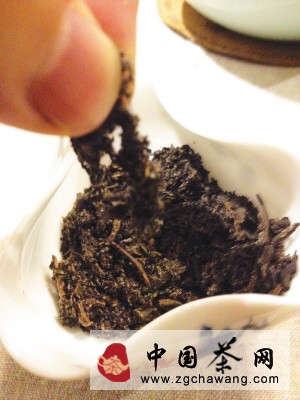
73 Green Cake and 8582 Green Cake. In the eyes of tea connoisseurs, collecting aged tea is not only about tasting its vintage flavor but also a cultural and spiritual enjoyment. Tea culture has never been solely about pursuing gustatory pleasure; the integration of humans and tea allows us to personally experience a spiritual communion with nature and the universe, truly nurturing the body, character, and mind! "Moss creeps up the steps, green; grass colors peer through the blinds," was the first impression upon entering the residence of Hainan collector Mr. Zhang Peng. He named his dwelling "Shan Yuan Ju" (Abode of Good Karma). Passing through a winding gravel path in front of the hall, the surroundings seemed much quieter, free from worldly noise, leaving only the ethereal and graceful sound of the zither, the rising wisps of tea fragrance, and display shelves filled with various teas and tea utensils.
"This is the century-old Pu-erh 'Song Pin Hao.' Its震撼口感 that melts in the mouth is believed to be unforgettable for those who have tasted it. This is the 1960s Qian Liang tea; the same pot of tea can be brewed dozens of times without changing its liquor color, with a mellow and smooth taste that lingers. This is the 1980s 8582 Green Cake..." Zhang Peng introduced his collection like counting treasures, and from his gaze, one could see the来之不易 of these stored teas.
Speaking of the stories behind tea收藏, Zhang Peng smiled and said, "As an enthusiast, I have always maintained an ordinary heart in selecting and storing tea; there aren't any particularly extraordinary stories."
Storing tea enhances both flavor and value. Chinese tea can be categorized into six major types based on processing techniques: green tea, white tea, yellow tea, oolong tea, black tea, and dark tea. Currently, the most sought-after by collectors are mostly dark teas, which have always held the highest收藏 value. In comparison, green tea and yellow tea are best when fresh, with optimal aroma and taste, thus having less收藏 value. However, dark tea improves with age. During the later stages of dark tea processing, fermentation occurs, cultivating specific microorganisms that produce oxidative enzymes, which react with the tea polyphenols in the leaves. Since then, the microorganisms within the tea remain active, and the oxidation of tea polyphenols continues. Therefore, as dark tea ages, the microbial community naturally evolves in a beneficial direction, enhancing its health functions and flavor over time, resulting in an increasingly better taste.
Zhang Peng believes that dark tea can be considered a collectible due to its uniqueness and scarcity. Unlike traditional collectibles such as antiques, ceramics, or paintings, tea cannot be visually appreciated or handled; it must be brewed and consumed, offering a dual享受 of taste and身心. Moreover, dark tea has an excellent taste and is beneficial to health, naturally making it beloved by people. Additionally, tea is a consumable; the process of drinking it also reduces its quantity. The aged teas people collect are irreplicable and non-renewable, which determines their scarcity.
Furthermore, the economic value of dark tea is quite similar to that of red wine—the older, the higher the value. Recent trends show that the price of high-end dark tea has increased by over 20% annually, a return far exceeding many other industries, even higher than real estate收益, with a very明显的 role in capital appreciation and preservation. This has also driven the收藏 value of dark tea steadily upward.
Pu-erh and Liubao are the top choices for collectors. Dark tea includes Yunnan Pu-erh tea, Guangxi Liubao tea, Hunan Qian Liang tea, etc., highly sought after by tea enthusiasts. Collectors particularly favor Pu-erh tea among dark teas, hailed as "drinkable古董." The craziest time for Pu-erh收藏 was in 2007 when优质普洱 from 2003, originally priced at 1000 yuan per cake, sold for over 20,000 yuan in 2007—a more than twenty-fold increase—even leading to scenes of distributors queuing for stock.
At that time, many people did not understand Pu-erh's收藏 value,甚至 ignoring the quality of the tea,盲目 collecting. On one hand, folk tales of miraculous effects like lowering血脂, weight loss, reducing blood sugar, warming the stomach, sobering up, and promoting salivation attracted public fervor. On the other hand, the soaring prices of aged Pu-erh sparked investor interest, leading成千上万的 tea friends to join the Pu-erh收藏 army, causing prices to skyrocket. However, the good times didn't last. By the end of 2007, the Pu-erh market crashed, and prices plummeted into the abyss. Today, Pu-erh market prices are climbing year by year, but people have become more rational in tea收藏, selecting the best to store, making high-end Pu-erh increasingly scarce and valuable.
Zhang Peng explained that Pu-erh should be categorized into three levels by era: First, Hao Ji Cha (商号级茶). Produced from the Qing Dynasty, Pu-erh was made by various商号 at that time, hence the name. Production continued until 1937 when Japan occupied Myanmar, blocking the tea routes and severely affecting Yunnan's tea industry, halting Hao Ji Cha production. Song Pin Hao, founded in the sixth year of the Guangxu reign (1880 AD), is recognized as the极品 among century-old teas, the ultimate pursuit for Pu-erh collectors. Pu-erh from this period was made using traditional techniques with better selection of materials. More importantly, they have been stored long enough, making them suitable for brewing. However, due to their extremely limited survival, they are precious and often difficult to obtain even with substantial money. Second, Yin Ji Cha (印级茶). In the early days of liberation, Pu-erh was uniformly produced and sold by the China National Tea Import & Export Corporation, all stamped with the "Zhong Cha" (中茶) mark, hence the name. Production of these teas stopped by the late Cultural Revolution. Representative examples include "Seven Sons Red印, Yellow印," etc. Yin Ji Cha is not only highly valuable珍品 but also a primary target for collectors and tea enthusiasts, as优质普洱, after sufficient aging, can achieve top-tier tasting quality. Third, Pu-erh produced from the late Cultural Revolution to the present, some of which also have considerable收藏 value, such as "73 Green Cake," "8582 Green Cake." These are also made with excellent materials and, having 30 years of陈韵, are considered quite rare.
While people enjoy and collect Pu-erh tea, Guangxi Liubao tea is gradually returning to the视野 of tea drinking enthusiasts. Like a dark horse, it has developed rapidly. Due to its significant price increases, recent起步, and巨大升值潜力, it is increasingly favored by collectors, becoming the首选 for some. The most glorious period in Liubao tea history was mainly through the famous "Tea Boat Ancient Road" from Guangxi to Guangdong, Hong Kong, Macau, and Southeast Asia, hence historically called "Qiao Xiao Cha" (侨销茶, tea sold to overseas Chinese). The climate in Southeast Asia is mostly hot and humid, and Liubao tea, known for its significant dampness-removing功效, became an essential beverage for local residents.
Zhang Peng said that in the 1950s and 1960s, Guangxi Liubao tea was大量 exported to Southeast Asia, with very little circulating domestically. Currently, the traditionally processed aged Liubao tea available domestically is mostly回流, and the存量 is also scarce, making老六堡 seen in the domestic market quite valuable. However, not many people truly recognize老六堡. There have been instances where inexperienced tea drinkers mistook二三十年的老六堡 for五六十年的老普洱. Some Liubao teas, after long-term storage, develop many "golden flowers" (金花, a type of beneficial fungus) on the surface, which can be observed upon close inspection.
Collecting's New Favorite: Wuyi Rock Tea. Among the six major tea categories, another不可不提 type is the oolong tea series' "Wuyi Rock Tea." The four famous丛 of Wuyi Mountain rock tea—"Da Hong Pao," "Tie Luo Han," "Shui Jin Gui," and "Bai Ji Guan"—each have their own characteristics. Many tea enthusiasts know that Wuyi Rock Tea "Da Hong Pao" is renowned worldwide,享有 "King of Tea"的美誉. Emperor Qianlong once praised Da Hong Pao highly: "Among them, Wuyi's product is the best, with a clear and harmonious aroma兼骨鲠 (a sense of strength or backbone)." In recent years, more and more tea drinking enthusiasts have discovered that rock tea, like dark tea, also possesses the characteristic of "improving with age," incorporating it into the realm of收藏. So, is Wuyi Rock Tea really suitable for收藏? And what are the most valuable varieties for收藏?
Zhang Peng said that rock tea is tea for one year, a treasure for three years, and medicine for ten years, with巨大收藏潜力. Stored Wuyi Rock Tea undergoes significant taste changes annually, especially traditionally charcoal-roasted Zheng Yan tea (正岩茶). No matter how many years it is stored, it will not experience返青 (regreening, loss of roasted flavor), does not need re-roasting, and its flavor becomes more aromatic and醇厚 with time, making it珍品 in收藏. Wuyi Rock Tea can be specifically categorized by origin into Zheng Yan tea (正岩茶), Ban Yan tea (半岩茶), and Zhou tea (洲茶). Zheng Yan tea refers to tea produced in the core area of Wuyi Mountain, San Keng Liang Jian (三坑两涧), known for its high quality,醇厚 aroma, and显岩韵 (pronounced rock rhyme). Ban Yan tea refers to tea produced in the peripheral areas of Wuyi Rock, with岩韵 slightly inferior to Zheng Yan tea. Zhou tea refers to tea produced along the banks of Chongxi, Jiuquxi, and Huangbaixi rivers near the Wuyi Rock两岸, with quality又逊于半岩茶.
The收藏心经 of Tea. Tea, as the foremost of the three non-alcoholic beverages, has strong收藏前景 with the普及 of health养生 concepts and the expansion of the consumer market. However, whether a tea is worth收藏, being "clean" is the most basic requirement. In the tea收藏界, there is the saying of '三不选' (three不选): First, tea with异味坚决不选; second, tea with霉点坚决不选; third, tea that causes锁喉 (throat-tightening sensation) when drunk坚决不选. So, what specific aspects should be noted in tea收藏?
Zhang Peng stated that truly good tea, whether smelled or tasted, will have a pleasant tea aroma, which is easy to distinguish. Tea with异味 often has issues during processing or storage and is no longer suitable for收藏. Moldy and锁喉 teas breed various harmful bacteria, not only losing their storage value but even posing health risks. To achieve a good tea, three main conditions are essential:优质茶箐 (high-quality tea leaves),精湛的加工工艺, and合理的仓储—none can be缺一不可. Storing tea requires a ventilated, dry,避光, and odor-free environment. Due to Hainan's relatively high air humidity, extra caution is needed in tea storage. It's best to control the temperature below 30°C and relative humidity not exceeding 70%, ensuring good茶品转化 without霉变. In fact, as a收藏 enthusiast, tea收藏 should决不应仅仅 be an economic行为 for profit. More importantly, one should have an "ordinary heart." Through tea收藏, one can enhance their inner修养. With a healthy mindset, perhaps your收藏之路 will bring you some unexpected惊喜.