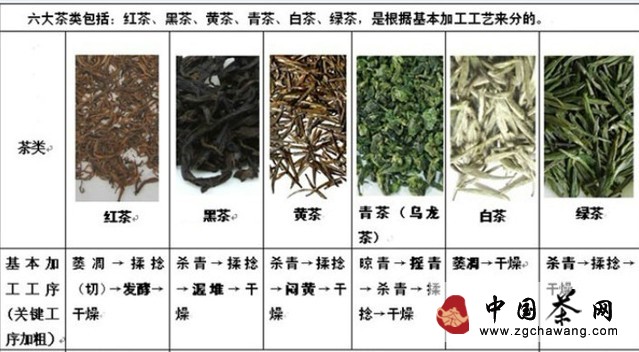
Tea is divided into six major categories, all originating from processing techniques.
A popular misconception circulating in the market links the six major tea categories to their degree of fermentation, which is somewhat erroneous. China's six major tea categories are fundamentally classified based on their production processes; other aspects are merely references, not the classification principle. For example: Taiwan Oriental Beauty tea, classified by process, is an oolong tea, yet its fermentation degree can reach about 70%; meanwhile, some delicate black teas popular on the market today have a fermentation degree of only 60% or even lower. Does this mean Oriental Beauty should be classified as a medium or even fully fermented tea? And should low-fermentation black tea be classified as semi-fermented? If we disregard the six major categories and classify solely by fermentation degree, this might seem feasible, but problems still exist. Taking white tea as an example, new white tea undergoes only withering, with fermentation below 15%, but storage can significantly increase its fermentation, even exceeding 60%. Would that make new white tea and aged white tea two different types? Raw Pu-erh tea faces the same issue—how can the same cake of tea change its category simply through aging? Therefore, using fermentation degree to classify tea is not a very reasonable principle.
The six basic categories—white tea, green tea, yellow tea, oolong tea, black tea, and dark tea—along with reprocessed tea and deep-processed tea, are all fundamentally classified based on the tea's production process. A good classification principle must encompass its subject matter without creating contradictions. The production process of finished tea is fixed and unchanging, so using processing for classification avoids errors. Besides processing, tea classification principles generally also include season, tea plant variety, and origin. For any tea, distinguishing by harvest season does not change over time; tea plant variety follows botanical classification methods, with the basic categories of arbor, semi-arbor, and shrub being well-established; classifying based on tea origin is also relatively reliable. However, none of these three classifications can clearly integrate discussions on quality, taste, aesthetic appeal, etc., so they often still rely on the processing-based classification. Generally, premium teas are defined by a comprehensive consideration of variety, season, origin, and processing. For example, 'Pre-Rain Lion Peak Longjing' specifies pre-rain first spring tea (season), Hangzhou's Lion Peak (origin), and Longjing (variety and processing).