When first starting to drink tea, you might hear tea enthusiasts exclaim with admiration, "This tea fuzz is so beautiful!" Then, following their lead, you carefully examine the almost invisible fine hairs floating in the tea broth, perhaps wondering—doesn't this make the tea look cloudy and dirty? What's so good about it?
This feature actually has a professional name: "tea fuzz." Simply put, these are the tiny, fine hairs on the buds and tips of tea leaves, containing abundant theanine.
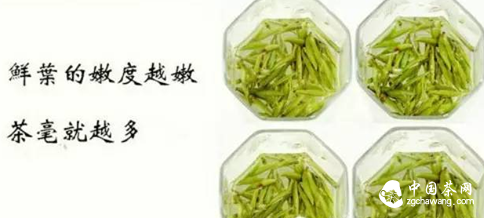
In spring, as temperatures rise and buds begin to sprout, the fuzz gradually grows. By the time the bud expands, the fuzz has reached a certain length, while the leaf itself has not yet fully unfurled, resulting in a high density of fuzz. Therefore, many premium teas are picked mainly as buds, one bud and one leaf, or one bud and two leaves. During processing, there is often a "fuzz-enhancing" step to make the tea fuzz more visually appealing.
Of course! Not all teas have noticeable fuzz.
The fuzz plays a crucial role in the appearance of many famous teas. High-grade Gongfu black teas, premium green teas, and white teas often emphasize visible fuzz. For example, top-grade Keemun and Dianhong black teas are prized for their golden fuzz on the bud tips; Huangshan Maofeng, Dongting Biluochun, and Xinyang Maojian are known for their silvery-white fuzz; Junshan Yinzhen and Huoshan Huangya are celebrated for their golden-yellow fuzz; while Baihao Yinzhen and Baimudan white teas are famed for their silvery fuzz.
However, not all teas highlight fuzz. Some everyday teas made from older, more mature leaves—such many pan-fired green teas like Ping Shui Zhu Cha—often do not emphasize this characteristic. Tea fuzz influences the quality and flavor of tea to varying degrees. For premium teas like Biluochun and Junshan Yinzhen, their rich, mellow broth and high, refreshing aroma are due not only to the tenderness and rich content of the fresh leaves but also in part to the abundance of fuzz. For many famous teas, the fuzz is a key element of their beautiful appearance, such as the white fuzz of white tea or the golden fuzz of high-grade black tea.
Having abundant fuzz on the fresh leaf buds is generally a positive trait for most tea types. Young buds and leaves with more fuzz often contribute to a higher freshness and umami taste in the brewed tea. Of course, it goes without saying that the amount of fuzz on tea leaves is not the only criterion for judging the quality of tea.