[Tea is a globally recognized healthy beverage, and drinking it 'correctly' is more beneficial to health. There are many articles about tea and health, often filled with Five Elements dialectics or medical terminology. The editor advocates clear, evidence-based writing that is easy for novice tea enthusiasts to understand. For more research by author Prof. Wang Yuefei (teaching at the Tea Science Department, College of Agriculture and Biotechnology, Zhejiang University) on tea culture and tea health, please refer to the book Tea Culture and Tea Health.]
I. Drinking Tea According to the Tea
Drinking tea according to the tea means adopting corresponding drinking methods based on different types of tea leaves. Everyone has heard the classification of the six major tea types many times. From a Traditional Chinese Medicine perspective, tea can be divided into cooling and warming natures. Therefore, we have created this diagram for tea, including Kuding tea as many people drink it, especially in summer.
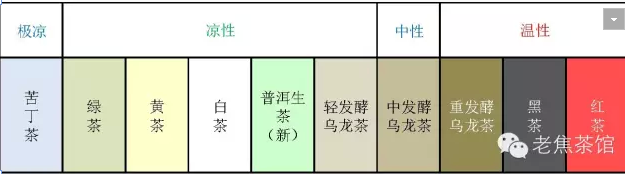
As shown in the diagram, Green tea, Yellow tea, and White tea belong to the cooling category; Oolong tea is neutral; Dark tea and Black tea are warming. The nature of the six major tea types can be considered from this angle, but it can be further refined. For example, Pu-erh tea: raw Pu-erh, when freshly made, is essentially a green tea and is cooling; ripe Pu-erh, especially aged for over 5 years, should be considered a warming tea. Oolong tea is similar: lightly fermented Oolong, like Wenshan Baozhong tea or the Jin Guanyin from Longquan, Zhejiang, which feels like green tea when brewed in a glass but has Oolong aroma, should also be a cooling tea; medium-fermented Oolong is neutral. Heavily fermented teas, like fully fermented black tea, are definitely warming; most dark teas belong to the warming category.
II. Drinking Tea According to the Person
Drinking tea according to the person means that each individual's constitution is different, so the specific way of drinking tea varies. A student once told me he drank chrysanthemum tea all year round but always had a sore throat. Western medicine prescriptions didn't help, but a TCM doctor told him the sore throat was caused by drinking chrysanthemum tea daily. We usually think chrysanthemum tea is good for the throat, but its extremely cooling nature can be harmful. After stopping chrysanthemum tea and switching to Pu-erh, Oolong, or black tea, his throat improved. Others may experience diarrhea from drinking green tea due to its cooling nature. While tea is generally thought to aid digestion, some may even experience constipation. Some people can't sleep all night after drinking tea. Others may see their blood pressure rise, though tea is typically considered to lower blood pressure—this happens in individuals particularly sensitive to caffeine. Some people even get 'tea drunk,' feeling worse than alcohol intoxication with palpitations and cold sweats, which is a hypoglycemic reaction in those with weak constitutions, especially when drinking tea on an empty stomach.
Therefore, drinking tea unsuitable for one's constitution may lead to physical discomfort. Consider this: if you have intense internal heat and drink black tea, it's like adding fuel to the fire, making the heat worse. Some people with cooler constitutions might get diarrhea from eating watermelon or bitter melon in summer; for them, drinking green tea in winter is like adding frost to snow.
So, what is constitution? It is the relatively stable inherent traits formed during life, based on innate endowment and acquired factors, encompassing morphological structure, physiological functions, and psychological state.
On April 9, 2009, China issued the Classification and Determination of Constitution in Traditional Chinese Medicine standard, dividing human constitution into 9 types. These 9 types and their corresponding characteristics are shown in the diagram below.
1. Balanced Constitution (Pinghezhi)
This is the normal, healthy constitution—the 'inspection-exempt' category at the hospital.
2. Qi-Deficient Constitution (Qixuzhi)
People with this type have deficient qi, often feel tired, have insufficient energy, and catch colds easily.
3. Yang-Deficient Constitution (Yangxuzhi)
This is commonly seen. Sometimes saying someone is 'yang deficient' sounds like an insult, but it actually means insufficient yang energy, causing fear of cold. Hands and feet are very cold in winter; they might need warm water to soak their feet before sleeping, and their feet may still be cold the next morning. They also have frequent bowel movements with loose stools.
4. Yin-Deficient Constitution (Yinxuzhi)
This is the opposite of Type 3. These individuals have internal heat, are not afraid of cold in winter, but cannot tolerate summer heat. They easily experience dry mouth and throat, hot palms and soles, dry eyes, and are prone to constipation.
5. Blood Stasis Constitution (Xueyuzhi)
People with this type have a dull complexion and gums that bleed easily. Sometimes, a slight pinch leaves a mark that doesn't fade quickly. Red blood vessels may also be visible in their eyes.
6. Phlegm-Dampness Constitution (Tanshizhi)
Characterized by obesity, a soft, full abdomen, easy sweating, oily skin, a thick tongue coating, and often a feeling of phlegm in the throat when speaking.
7. Damp-Heat Constitution (Shirezhi)
These individuals have an oily, shiny face, are prone to acne when young, and have itchy skin. They may experience a bitter taste in the mouth or bad breath, especially noticeable if they stay up late.
8. Qi-Stagnation Constitution (Qiyuzhi)
This is the 'Lin Daiyu' type (from Dream of the Red Chamber)—sentimental, emotionally fragile, and often relatively thin.
9. Special Constitution (Tebingzhi)
This refers to allergic constitutions. Many are allergic to pollen; some are even allergic to caffeine in tea and may vomit after drinking it.
How Different People Should Drink Tea
So, how should people of different constitutions drink tea? After careful study, I believe those with a Balanced Constitution (Type 1) can drink any tea. Those with Qi-Deficient Constitution (Type 2) should avoid high-caffeine teas and cooling teas; they generally should drink ripe Pu-erh and moderately to heavily fermented Oolong teas. Yang-Deficient individuals (Type 3) should not drink green tea, especially steamed green tea, nor yellow tea or Kuding tea. They should drink more black tea, dark tea, and heavily fermented Oolong teas (like Wuyi Rock Tea).
Yin-Deficient constitution (Type 4) is the opposite of Yang-Deficient. They should drink more green tea, yellow tea, white tea, Kuding tea, and lightly fermented Oolong tea. We suggest adding goji berries when drinking tea, or drinking chrysanthemum, cassia seed tea. They should drink less or avoid black tea, dark tea, and heavily fermented Oolong tea.
Those with Blood Stasis Constitution (Type 5) can drink all kinds of tea, even stronger brews, preferably with added hawthorn, rose petals, brown sugar, or even tea polyphenol tablets.
For Phlegm-Dampness Constitution (Type 6), I think they should drink strong tea of any kind, and can also add dried tangerine peel.
Those with Damp-Heat Constitution (Type 7) should drink more green tea, yellow tea, white tea, Kuding tea, and lightly fermented Oolong tea. They can also add goji berries, chrysanthemum, or cassia seeds. They should drink less black tea, dark tea, and heavily fermented Oolong tea. We recommend tea candy, which may be more beneficial for them.
What about 'Lin Daiyu,' or those with Qi-Stagnation Constitution (Type 8)? They can drink Anji white tea. If Lin Daiyu had drunk Anji white tea (though it might not have existed then), she might not have passed away so early. Those who care for her should give her teas with relatively low caffeine, lighter brews, or even rose tea, teas containing aromatic components, honeysuckle tea, hawthorn tea, kudzu root tea, or finger citron tea. Relatively light, mild teas should be suitable.
Those with Special Constitution (Type 9) might as well not drink tea. If they do, it should be very light. Like those with gout or neurasthenia, they can discard the first or even second infusion and drink lightly. Drinking teas like Anji white tea, which are low in caffeine and high in theanine, is acceptable.
Therefore, it is recommended to first determine your constitution type, then choose suitable tea. However, constitution is interesting; one person may simultaneously possess traits of several constitutions. I once measured a friend's constitution with interest. As shown in the diagram, on July 27th, his constitution was as in the top row; half a month later, on August 10th, it was as in the bottom row. The same person, overall quite healthy, primarily Balanced with a tendency towards Yang-Deficiency, so he can drink any tea, just less green tea. Within half a month, his body changed significantly. He reported a more regular lifestyle, fewer social engagements, and an overall improvement in health.
Overall, the relationship between constitution and tea drinking is that individuals with a 'hot' constitution should drink more cooling teas, while those with a 'cold' constitution should drink more warming teas—this is the general principle. Furthermore, our physical condition is dynamic and may change at any time; we hope our constitution changes for the better. Some people's constitutions may have many contradictory elements simultaneously, which is more complicated. Also, for any constitution, tasting a little of any tea type is generally fine. For example, if you want to try a famous green tea (cooling), having one cup is usually not a big problem. If you feel unwell, you can immediately switch to black tea. Some people are very particular about tea, even loyal to one type. My teacher, Professor Yang Xianqiang, who lived in Zhejiang for 50-60 years, prefers Oolong tea most, though he tastes others. Some people are strongly partial to a certain tea, and long-term consumption may shift their constitution in that direction.
So, we should consider our constitution when drinking tea, hoping the tea guides our constitution onto the right path rather than pushing it into an 'abyss.' In short, for anyone, drinking tea is definitely better than not drinking tea. That's the relationship between constitution and tea drinking. There is much more to study here, and I hope everyone can join me in further research.
Additionally, tea drinking varies with professional environment and job. For example, computer workers should drink more teas that resist radiation; mental workers, including teachers and students, should drink teas that make thinking more agile.
For all professions, I recommend tea polyphenol tablets, which I think may be suitable for everyone. Furthermore, tea drinking also varies with personal preference. Beginners or those who don't regularly drink tea are suited to lighter, fresher, high-amino-acid teas like Anji white tea. Veteran tea drinkers might find a handful of leaves in a cup insufficient and prefer stronger brews, though some veterans also drink light tea. Some have the habit of blending, adding lemon, jasmine, rose, or making milk tea. This can all be adjusted according to personal preference.
So, how to judge if a tea is suitable for you? If you don't know your constitution and have no time to determine it, you can observe if your body shows adverse reactions, mainly in two aspects: First, if you drink green tea and immediately feel stomach discomfort or need to use the restroom, it indicates a cooler constitution, so switch to warming teas. Second, if drinking a certain tea causes insomnia, dizziness, or 'tea drunkenness,' then you definitely cannot drink strong tea. If you feel very good after drinking a certain tea—less prone to colds, very energetic—then you can drink it long-term. In other words, you can drink tea based on your own feelings.
III. Drinking Tea According to the Time
Drinking tea according to the time means drinking different teas at different times. Tea drinking should be adjusted according to the season because our bodies may change with the seasons—for example, a person's constitution in winter may differ from that in summer. Here are a few lines: 'Drink scented tea in spring to regulate stagnation, drink green tea in summer to dispel summer heat and dampness. Savor Oolong in autumn to relieve dryness and heat, drink black tea in winter to warm the spleen and stomach.' That is, you can drink different teas in the four seasons.
Some people are even more particular, changing teas four or five times a day—different teas upon waking, after breakfast, after lunch, in the afternoon, and in the evening. This might be a bit too particular, but if you have the time and interest, you can try it.