Pu-erh tea is the most unique tea among tea leaves. It becomes more fragrant with long-term storage. However, many people cannot distinguish what others refer to as the aroma of Pu-erh tea. Today's topic will explain this in detail from different dimensions. First, let's carefully study the profundity of Chinese characters:
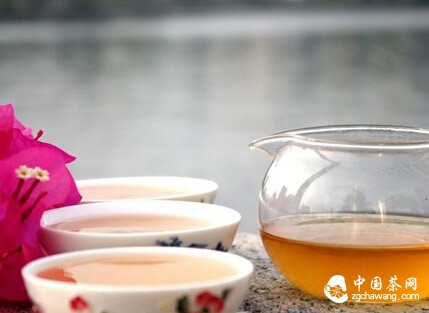
"Qi" and "Wei"
The traditional Chinese philosophical concept of "qi," sometimes written as "气," is not entirely the same as the modern physical concept of gas. Qi is a common concept in Chinese philosophy, Taoism, and traditional Chinese medicine. In TCM, it refers to the most fundamental energy that constitutes the human body and sustains life activities, also having the meaning of physiological function. Scent, smell: In Chinese materia medica, it refers to the special odor of drugs containing volatile substances. Modernly, qi is a flowing "unity of 'information-energy-matter'." [TCM terminology]
The basic meaning of "wei" is the sensation obtained by the tongue tasting something or the nose smelling something, extended to mean interest, experience. In Chinese medicine, it can also be used as a measure word, such as five "wei" of medicine.
Having basically explained "qi" and "wei," then what is "xiang" (fragrance)? It is explained as: a pleasant smell. Based on the above character explanations, the combined term Pu-erh tea fragrance (aroma, scent) is still unclear. Don't worry, let's now distinguish from the perspective of human sensory organs: "mouth"—taste and "nose"—smell. So, as long as you distinguish the sensations of these two organs, you should understand what kind of fragrance Pu-erh tea actually offers. However, some Pu-erh tea fragrances are perceived by both organs.
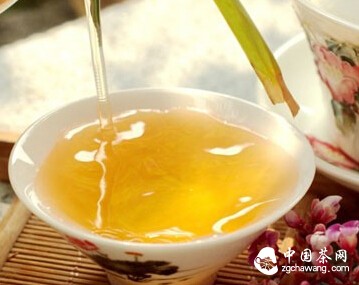
Due to differences in production techniques, material selection, and tea regions, Pu-erh tea's fragrances are categorized into camphor fragrance, orchid fragrance, lotus fragrance, date fragrance, honey fragrance, and honey-orchid fragrance. The honey-orchid fragrance is widely recognized as the best. From the perspective of tea soup aroma and fragrance, Pu-erh tea is further divided into surface aroma, taste aroma, base aroma, cold cup aroma, aftertaste aroma, and wet leaf aroma.
1. Surface aroma (nose): When boiling water is poured onto the leaves, the tea fragrance emerges. Sometimes, one specifically covers the lid of the gaiwan or teapot, lets it steep for a short while, then opens it and takes a deep sniff, immediately greeted by a rich aroma. The surface aroma of Pu-erh tea soup is determined by the inherent nature of the tea itself and cannot be used to judge the quality of the tea.
2. Taste aroma (mouth): The taste aroma is similar to the surface aroma of the tea soup, but it is not smelled; it is perceived through drinking. The most obvious example is Yiwu tea. This tea soup aroma cannot be described as "fragrance filling the mouth and teeth"; it is very delicate and lingering. It is wrapped within the tea soup,含蓄不露 (subtle and not overt), and can only be detected by taking small sips and savoring carefully, revealing a faint, elusive feeling.
3. Base aroma (nose): The base aroma is a favorite among experienced tea drinkers and connoisseurs. If you observe carefully, you will notice that when drinking Pu-erh tea, they do not put down the cup. From time to time, while the cup is still warm, they smell the last drop of tea soup to appreciate the aroma it reveals—a truly delightful experience.
4. Cold cup aroma (nose): Also called cup-bottom aroma, it is closely connected to the base aroma. The cold cup aroma is the subtle, faint, lingering fragrance emitted from the tasting cup after the tea soup is finished. If you try hard to smell it, it disappears; if you are calm and patient, it reveals itself. Sometimes the cold cup-bottom aroma is like a gentle spring rain, omnipresent. Sometimes it is like fish in water, fleeting.
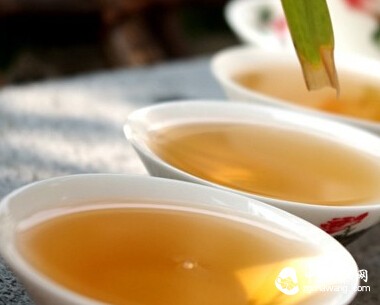
5. Aftertaste aroma (mind): The aftertaste aroma seems somewhat mystical; it is a fragrance recalled in memory. Everyone has different tea-drinking experiences. For example, when some people drink a certain tea again, even before the leaves fully unfurl, they suddenly remember what tea it is.
6. Wet leaf aroma (nose): The wet leaf aroma is divided into two types: hot sniffing and cold sniffing. Generally, good raw Pu-erh tea leaves, after cooling, carry a fresh plant fragrance. Hot sniffing is usually used for ripe Pu-erh tea; generally, ripe tea that hasn't aged enough will carry a fermentation (wo dui) odor and some miscellaneous smells.
Author: Yang Chen'ai
Source: Tea Bubble Network