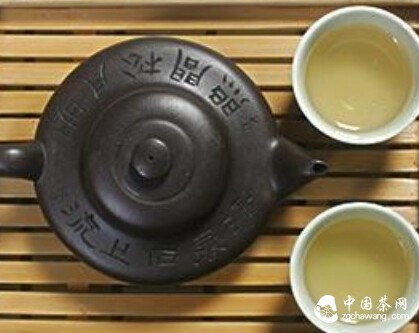
Oolong tea, also known as green tea, is a semi-fermented tea between green tea (unfermented) and black tea (fully fermented). Therefore, it has the fresh fragrance of green tea and the sweet taste of black tea, and skillfully suppresses the astringency of black tea and the bitterness of green tea.
The general steps of oolong tea processing include: sun-drying, withering, shaking, rolling, drying, and stem sorting. The necessary conditions for brewing a good pot of oolong tea are as follows:
I. Good tea, good water, good teaware
As the saying goes: “Water is the mother of tea, and teaware is the father of tea.” With good tea leaves, good water and good teaware are even more necessary to fully express its charm. The best water is purified or mineral water, and the best teaware is “Yixing pottery and Jingdezhen porcelain.”
II. Teapot shape and tea leaf amount
Choose the teapot shape according to the number of tea drinkers, and determine the amount of tea leaves based on the teapot capacity. If the tea leaves are tightly rolled hemispherical oolong, the leaves should account for 1/3 to 1/4 of the teapot volume; if the leaves are looser, they should account for half of the teapot.
III. Water temperature requirement
Since oolong tea contains certain special aromatic substances that can only be fully released at high temperatures, it must be brewed with boiling water.
IV. Steeping time
For oolong teas from southern Fujian and Taiwan, the first infusion generally lasts about 45 seconds, the second infusion about 60 seconds, and each subsequent infusion is extended by about 10 seconds. For oolong teas from northern Fujian and Chaozhou, the steeping time is much faster—the first infusion only needs 15 seconds.
V. Number of infusions
Green tea is usually best after three infusions, while oolong tea is said to have “fragrance remaining after seven infusions.” With proper brewing, each pot can be steeped seven times or more.
Oolong teas on the market can be classified by origin into southern Fujian, northern Fujian, Guangdong Chaozhou, and Taiwan.
Southern Fujian oolong tea is also called Anxi tea, with representative famous teas including Anxi Tieguanyin, Huangjinguì, Benshan, and Maoxie; northern Fujian oolong tea is also called rock tea, mainly produced in the Wuyi Mountain area of Fujian, with representative famous teas such as Dahongpao, Rougui, Tie Luohan, and Shuixian; Guangdong Chaozhou oolong tea is known for Phoenix Dan Cong; Taiwan oolong tea is mainly produced in Taiwan and is divided into Taiwan oolong and Taiwan Baozhong due to different fermentation processes. Dongding Oolong, Qingxin Oolong, and Wenshan Baozhong are very famous, but in recent years, Taiwan teas such as Jinxuan and Cuiyu have also become popular.
Anxi Tieguanyin oolong tea has a rich, mellow, and lingering aroma, with a thick, fresh, and sweet aftertaste. The leaf base has reddish-brown edges and a pale green center, forming a unique “green leaves with red edges.” In terms of liquor color, northern Fujian tea and southern Fujian tea differ: northern Fujian oolong tea has a darker liquor color, while southern Fujian oolong tea has a clear and bright liquor color.
Special reminder:
Strictly speaking, ginseng oolong tea (Anxi Tieguanyin) is not an original-flavor tea. It is a reprocessed tea made by adding crushed ginseng leaves and other ingredients to tea leaves. High-quality ginseng oolong tea has certain health benefits.
There is a simple method to judge the quality of ginseng oolong tea: the faster the tea leaves spread during brewing, the better the tea quality. Many ginseng oolong teas on the market are made from aged tea leaves, so consumers should pay attention when purchasing.