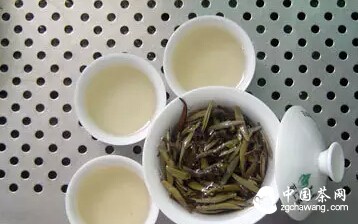
White tea belongs to the lightly fermented tea category (fermentation degree 10% to 20%). Its manufacturing process is unique, mainly divided into two parts: withering and drying. The dry tea surface is densely covered with white down. This quality characteristic is formed, firstly, by picking tender buds and leaves rich in fine hairs; secondly, by adopting a sun-drying or baking process without frying or rolling. White tea types: bud tea and leaf tea. Bud tea: Baihao Yinzhen (Silver Needle); Leaf tea: Baimudan (White Peony), Gongmei, etc.
Baihao Yinzhen processing method: tea buds → withering → baking → screening/sorting → re-firing → packing; Baimudan, Gongmei processing method: fresh leaves → withering → baking (or shade-drying) → sorting (or screening) → re-firing → packing.
Re-firing: is one of the refining processes for tea leaves, meaning drying again. Re-firing methods include baking and frying. Red tea is baked, while green tea uses both baking and frying. Baking tea usually uses a drying machine; frying tea commonly uses a frying pan machine or a drum roasting and polishing machine, which can both fry and polish the tea. The purpose of baking or frying, besides evaporating moisture, is to improve the tea's color, aroma, taste, and shape. More importantly, before the refining process, due to long-term storage and long-distance transportation, the moisture content of raw tea increases, causing the appearance to become soft, volume to expand, making sieving and winnowing difficult and affecting the screening efficiency. Therefore, re-firing is done first. Re-firing operations mostly use drying machines. The inlet hot air temperature for red tea is 110–120°C, and for green tea, 120–140°C.
Coarse, old tea requires higher firing temperature, while tender, delicate tea needs protection from high heat. Larger tea leaves should be fired at a higher temperature than smaller ones. The baking/frying time for large, coarse tea strips is longer than for smaller ones; tender tea leaves have stronger heat resistance than coarse, old ones, thus requiring shorter time. During spring and summer tea production periods, which coincide with the rainy season, the firing temperature should be appropriately increased; in autumn when the weather is dry, the firing temperature can be appropriately lowered.